Unknown work
(1684?C1721).
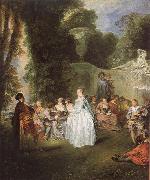
French painter of Flemish descent, b. Valenciennes. Until 1704 poverty forced him to work in the shops of mediocre artists, where he produced genre and devotional subjects. In 1704?C8 he studied in the studio of Claude Gillot, an adept painter of scenes of theatrical life, which later became the subject of some of Watteau's finest paintings, such as Love in the Italian Theatre and Love in the French Theatre (both: Berlin). In 1708?C9 Watteau worked with the decorator Claude Audran. Watteau attracted the attention of eminent patrons in his last years, including the comte de Caylus, his biographer, and in 1717 he was made a full member of the Acad??mie royale. The Embarkation for Cythera (1717; Louvre) is characteristic of his art; it is a delicate, courtly fantasy, represented in warm and shimmering pastel tones that place him among the great colorists of all time. A lyric, Giorgionesque quality pervades his airy, gay, and sensuous scenes, which have a poignancy that none of his followers attained. Out of the most fleeting aspects of life he created an enduring and individual art. His exquisite paintings influenced fashion and garden design in the 18th cent. Other outstanding works include Gilles (Louvre), Perspective (Mus. of Fine Arts, Boston), Mezzetin (Metropolitan Mus.), and Gersaint's Shop Sign (1719; Berlin). mk191
about 1718-1719
Oil on canvas
55.9x45.7cm
Painting ID:: 48665
Unknown work
British
1723-1792
Sir Joshua Reynolds Locations
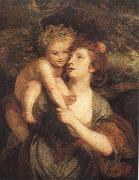
Reynolds was born in Plympton, Devon, on 16 July 1723. As one of eleven children, and the son of the village school-master, Reynolds was restricted to a formal education provided by his father. He exhibited a natural curiosity and, as a boy, came under the influence of Zachariah Mudge, whose Platonistic philosophy stayed with him all his life.
Showing an early interest in art, Reynolds was apprenticed in 1740 to the fashionable portrait painter Thomas Hudson, with whom he remained until 1743. From 1749 to 1752, he spent over two years in Italy, where he studied the Old Masters and acquired a taste for the "Grand Style". Unfortunately, whilst in Rome, Reynolds suffered a severe cold which left him partially deaf and, as a result, he began to carry a small ear trumpet with which he is often pictured. From 1753 until the end of his life he lived in London, his talents gaining recognition soon after his arrival in France.
Reynolds worked long hours in his studio, rarely taking a holiday. He was both gregarious and keenly intellectual, with a great number of friends from London's intelligentsia, numbered amongst whom were Dr Samuel Johnson, Oliver Goldsmith, Edmund Burke, Giuseppe Baretti, Henry Thrale, David Garrick and fellow artist Angelica Kauffmann. Because of his popularity as a portrait painter, Reynolds enjoyed constant interaction with the wealthy and famous men and women of the day, and it was he who first brought together the famous figures of "The" Club.
With his rival Thomas Gainsborough, Reynolds was the dominant English portraitist of 'the Age of Johnson'. It is said that in his long life he painted as many as three thousand portraits. In 1789 he lost the sight of his left eye, which finally forced him into retirement. In 1791 James Boswell dedicated his Life of Samuel Johnson to Reynolds.
Reynolds died on 23 February 1792 in his house in Leicester Fields, London. He is buried in St. Paul's Cathedral. mk191
1772
Oil on canvas
89x68.5cm
Painting ID:: 48666
Unknown work
1776-1837
British
John Constable Locations
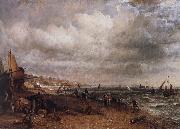
1837). English painter and draughtsman. His range and aspirations were less extensive than those of his contemporary J. M. W. Turner, but these two artists have traditionally been linked as the giants of early 19th-century British landscape painting and isolated from the many other artists practising landscape at a time when it was unprecedentedly popular. Constable has often been defined as the great naturalist and deliberately presented himself thus in his correspondence, although his stylistic variety indicates an instability in his perception of what constituted nature. He has also been characterized as having painted only the places he knew intimately, which other artists tended to pass by. While the exclusivity of Constable approach is indisputable, his concern with local scenery was not unique, being shared by the contemporary Norwich artists. By beginning to sketch in oil from nature seriously in 1808, he also conformed with the practice of artists such as Thomas Christopher Hofland (1777-1843), William Alfred Delamotte, Turner and, particularly, the pupils of John Linnell. Turner shared his commitment to establishing landscape as the equal of history painting, despite widespread disbelief in this notion. Nevertheless, although Constable was less singular than he might have liked people to believe, his single-mindedness in portraying so limited a range of sites was unique, and the brilliance of his oil sketching unprecedented, while none of his contemporaries was producing pictures resembling The Haywain (1821; London, N.G.) or the Leaping Horse (1825; London, RA). This very singularity was characteristic of British artists at a time when members of most occupations were stressing their individuality in the context of a rapidly developing capitalist economy mk191
1827
Oil on canvas
127x183cm
Painting ID:: 48670
Unknown work
1776-1837
British
John Constable Locations
1837). English painter and draughtsman. His range and aspirations were less extensive than those of his contemporary J. M. W. Turner, but these two artists have traditionally been linked as the giants of early 19th-century British landscape painting and isolated from the many other artists practising landscape at a time when it was unprecedentedly popular. Constable has often been defined as the great naturalist and deliberately presented himself thus in his correspondence, although his stylistic variety indicates an instability in his perception of what constituted nature. He has also been characterized as having painted only the places he knew intimately, which other artists tended to pass by. While the exclusivity of Constable approach is indisputable, his concern with local scenery was not unique, being shared by the contemporary Norwich artists. By beginning to sketch in oil from nature seriously in 1808, he also conformed with the practice of artists such as Thomas Christopher Hofland (1777-1843), William Alfred Delamotte, Turner and, particularly, the pupils of John Linnell. Turner shared his commitment to establishing landscape as the equal of history painting, despite widespread disbelief in this notion. Nevertheless, although Constable was less singular than he might have liked people to believe, his single-mindedness in portraying so limited a range of sites was unique, and the brilliance of his oil sketching unprecedented, while none of his contemporaries was producing pictures resembling The Haywain (1821; London, N.G.) or the Leaping Horse (1825; London, RA). This very singularity was characteristic of British artists at a time when members of most occupations were stressing their individuality in the context of a rapidly developing capitalist economy mk191
Oil on canvas
1827
127x183cm
Painting ID:: 48671
Unknown work
French Romantic Painter, 1798-1863
For 40 years Eugene Delacroix was one of the most prominent and controversial painters in France. Although the intense emotional expressiveness of his work placed the artist squarely in the midst of the general romantic outpouring of European art, he always remained an individual phenomenon and did not create a school. As a personality and as a painter, he was admired by the impressionists, postimpressionists, and symbolists who came after him.
Born on April 28, 1798, at Charenton-Saint-Maurice, the son of an important public official, Delacroix grew up in comfortable upper-middle-class circumstances in spite of the troubled times. He received a good classical education at the Lycee Imperial. He entered the studio of Pierre Narcisse Guerin in 1815, where he met Theodore Gericaul mk191
1840
410x498cm
Painting ID:: 48672
Unknown work
1827-1910
British
William Holman Hunt Galleries
Hunt's intended middle name was "Hobman", which he disliked intensely. He chose to call himself Holman when he discovered that his middle name had been misspelled this way after a clerical error at his baptism at the church of Saint Mary the Virgin, Ewell.[1] Though his surname is "Hunt", his fame in later life led to the inclusion of his middle name as part of his surname, in the hyphenated form "Holman-Hunt", by which his children were known.
After eventually entering the Royal Academy art schools, having initially been rejected, Hunt rebelled against the influence of its founder Sir Joshua Reynolds. He formed the Pre-Raphaelite movement in 1848, after meeting the poet and artist Dante Gabriel Rossetti. Along with John Everett Millais they sought to revitalise art by emphasising the detailed observation of the natural world in a spirit of quasi-religious devotion to truth. This religious approach was influenced by the spiritual qualities of medieval art, in opposition to the alleged rationalism of the Renaissance embodied by Raphael. He had many pupils including Robert Braithwaite Martineau (best known for his work "Last Days in the Old Home") who was a moderately successful painter although he died young.
The Hireling Shepherd, 1851Hunt's works were not initially successful, and were widely attacked in the art press for their alleged clumsiness and ugliness. He achieved some early note for his intensely naturalistic scenes of modern rural and urban life, such as The Hireling Shepherd and The Awakening Conscience. However, it was with his religious paintings that he became famous, initially The Light of the World (now in the chapel at Keble College, Oxford, with a later copy in St Paul's Cathedral), having toured the world. After travelling to the Holy Land in search of accurate topographical and ethnographical material for further religious works, Hunt painted The Scapegoat, The Finding of the Saviour in the Temple and The Shadow of Death, along with many landscapes of the region. Hunt also painted many works based on poems, such as Isabella and The Lady of Shalott.
All these paintings were notable for their great attention to detail, their hard vivid colour and their elaborate symbolism. These features were influenced by the writings of John Ruskin and Thomas Carlyle, according to whom the world itself should be read as a system of visual signs. For Hunt it was the duty of the artist to reveal the correspondence between sign and fact. Out of all the members of the Pre-Raphaelite Brotherhood Hunt remained most true to their ideals throughout his career. He eventually had to give up painting because failing eyesight meant that he could not get the level of quality that he wanted. His last major work, The Lady of Shalott, was completed with the help of an assistant (Edward Robert Hughes).
Hunt married twice. After a failed engagement to his model Annie Miller, he married Fanny Waugh, who later modelled for the figure of Isabella. When she died in childbirth in Italy he sculpted her tomb up at Fiesole, having it brought down to the English Cemetery, beside the tomb of Elizabeth Barrett Browning. His second wife, Edith, was Fanny's sister. At this time it was illegal in Britain to marry one's deceased wife's sister, so Hunt was forced to travel abroad to marry her. This led to a serious breach with other family members, notably his former Pre-Raphaelite colleague Thomas Woolner, who had married Fanny and Edith's third sister Alice.
Hunt's autobiography Pre-Raphaelitism and the Pre-Raphaelite Brotherhood (1905) was written to correct other literature about the origins of the Brotherhood, which in his view did not adequately recognise his own contribution. Many of his late writings are attempts to control the interpretation of his work.
In 1905, he was appointed to the Order of Merit by King Edward VII. At the end of his life he lived in Sonning-on-Thames. mk191
1853
Oil on canvas
76.2x55.8cm
Painting ID:: 48677
Unknown work
1819-1877
French
Gustave Courbet Locations
was a French painter whose powerful pictures of peasants and scenes of everyday life established him as the leading figure of the realist movement of the mid-19th century.
Gustave Courbet was born at Ornans on June 10, 1819. He appears to have inherited his vigorous temperament from his father, a landowner and prominent personality in the Franche-Comte region. At the age of 18 Gustave went to the College Royal at Besancon. There he openly expressed his dissatisfaction with the traditional classical subjects he was obliged to study, going so far as to lead a revolt among the students. In 1838 he was enrolled as an externe and could simultaneously attend the classes of Charles Flajoulot, director of the ecole des Beaux-Arts. At the college in Besançon, Courbet became fast friends with Max Buchon, whose Essais Poetiques (1839) he illustrated with four lithographs.
In 1840 Courbet went to Paris to study law, but he decided to become a painter and spent much time copying in the Louvre. In 1844 his Self-Portrait with Black Dog was exhibited at the Salon. The following year he submitted five pictures; only one, Le Guitarrero, was accepted. After a complete rejection in 1847, the Liberal Jury of 1848 accepted all 10 of his entries, and the critic Champfleury, who was to become Courbet first staunch apologist, highly praised the Walpurgis Night. mk191
1886
Oil on canvas
174x209cm
Painting ID:: 48682
Unknown work
1819-1877
French
Gustave Courbet Locations
was a French painter whose powerful pictures of peasants and scenes of everyday life established him as the leading figure of the realist movement of the mid-19th century.
Gustave Courbet was born at Ornans on June 10, 1819. He appears to have inherited his vigorous temperament from his father, a landowner and prominent personality in the Franche-Comte region. At the age of 18 Gustave went to the College Royal at Besancon. There he openly expressed his dissatisfaction with the traditional classical subjects he was obliged to study, going so far as to lead a revolt among the students. In 1838 he was enrolled as an externe and could simultaneously attend the classes of Charles Flajoulot, director of the ecole des Beaux-Arts. At the college in Besançon, Courbet became fast friends with Max Buchon, whose Essais Poetiques (1839) he illustrated with four lithographs.
In 1840 Courbet went to Paris to study law, but he decided to become a painter and spent much time copying in the Louvre. In 1844 his Self-Portrait with Black Dog was exhibited at the Salon. The following year he submitted five pictures; only one, Le Guitarrero, was accepted. After a complete rejection in 1847, the Liberal Jury of 1848 accepted all 10 of his entries, and the critic Champfleury, who was to become Courbet first staunch apologist, highly praised the Walpurgis Night. mk191
1886
174x209cm
Painting ID:: 48683
Unknown work
1819-1877
French
Gustave Courbet Locations
was a French painter whose powerful pictures of peasants and scenes of everyday life established him as the leading figure of the realist movement of the mid-19th century.
Gustave Courbet was born at Ornans on June 10, 1819. He appears to have inherited his vigorous temperament from his father, a landowner and prominent personality in the Franche-Comte region. At the age of 18 Gustave went to the College Royal at Besancon. There he openly expressed his dissatisfaction with the traditional classical subjects he was obliged to study, going so far as to lead a revolt among the students. In 1838 he was enrolled as an externe and could simultaneously attend the classes of Charles Flajoulot, director of the ecole des Beaux-Arts. At the college in Besançon, Courbet became fast friends with Max Buchon, whose Essais Poetiques (1839) he illustrated with four lithographs.
In 1840 Courbet went to Paris to study law, but he decided to become a painter and spent much time copying in the Louvre. In 1844 his Self-Portrait with Black Dog was exhibited at the Salon. The following year he submitted five pictures; only one, Le Guitarrero, was accepted. After a complete rejection in 1847, the Liberal Jury of 1848 accepted all 10 of his entries, and the critic Champfleury, who was to become Courbet first staunch apologist, highly praised the Walpurgis Night. mk191
Oil on canvas
Painting ID:: 48684
Unknown work
1819-1877
French
Gustave Courbet Locations
was a French painter whose powerful pictures of peasants and scenes of everyday life established him as the leading figure of the realist movement of the mid-19th century.
Gustave Courbet was born at Ornans on June 10, 1819. He appears to have inherited his vigorous temperament from his father, a landowner and prominent personality in the Franche-Comte region. At the age of 18 Gustave went to the College Royal at Besancon. There he openly expressed his dissatisfaction with the traditional classical subjects he was obliged to study, going so far as to lead a revolt among the students. In 1838 he was enrolled as an externe and could simultaneously attend the classes of Charles Flajoulot, director of the ecole des Beaux-Arts. At the college in Besançon, Courbet became fast friends with Max Buchon, whose Essais Poetiques (1839) he illustrated with four lithographs.
In 1840 Courbet went to Paris to study law, but he decided to become a painter and spent much time copying in the Louvre. In 1844 his Self-Portrait with Black Dog was exhibited at the Salon. The following year he submitted five pictures; only one, Le Guitarrero, was accepted. After a complete rejection in 1847, the Liberal Jury of 1848 accepted all 10 of his entries, and the critic Champfleury, who was to become Courbet first staunch apologist, highly praised the Walpurgis Night. mk190
Oil on canvas
Painting ID:: 48685
Unknown work
1830-1903
French
Camille Pissarro Locations
Painter and printmaker. He was the only painter to exhibit in all eight of the Impressionist exhibitions held between 1874 and 1886, and he is often regarded as the father of the movement. He was by no means narrow in outlook, however, and throughout his life remained as radical in artistic matters as he was in politics. Thadee Natanson wrote in 1948: Nothing of novelty or of excellence appeared that Pissarro had not been among the first, if not the very first, to discern and to defend. The significance of Pissarro work is in the balance maintained between tradition and the avant-garde. Octave Mirbeau commented: M. Camille Pissarro has shown himself to be a revolutionary by renewing the art of painting in a purely working sense; at the same time he has remained a purely classical artist in his love for exalted generalizations, his passion for nature and his respect for worthwhile traditions.
mk191
1867
91x150.5cm
Painting ID:: 48691
Unknown work
French Impressionist Painter, 1841-1919
French painter, printmaker and sculptor. He was one of the founders and leading exponents of IMPRESSIONISM from the late 1860s, producing some of the movement's most famous images of carefree leisure. He broke with his Impressionist colleagues to exhibit at the Salon from 1878, and from c. 1884 he adopted a more linear style indebted to the Old Masters.
His critical reputation has suffered from the many minor works he produced during his later years. mk191
1867
105x73.5cm
Painting ID:: 48692
Unknown work
French Impressionist Painter, 1840-1926
Claude Oscar Monet (14 November 1840 C 5 December 1926) was a founder of French impressionist painting, and the most consistent and prolific practitioner of the movement's philosophy of expressing one's perceptions before nature, especially as applied to plein-air landscape painting. The term Impressionism is derived from the title of his painting.
Claude Monet was born on 14 November 1840 on the fifth floor of 45 rue Laffitte, in the ninth arrondissement of Paris . He was the second son of Claude-Adolphe and Louise-Justine Aubree Monet, both of them second-generation Parisians. On 20 May 1841, he was baptised into the local church parish, Notre-Dame-de-Lorette as Oscar-Claude. In 1845, his family moved to Le Havre in Normandy. His father wanted him to go into the family grocery store business, but Claude Monet wanted to become an artist. His mother was a singer.
On the first of April 1851, Monet entered the Le Havre secondary school of the arts. He first became known locally for his charcoal caricatures, which he would sell for ten to twenty francs. Monet also undertook his first drawing lessons from Jacques-François Ochard, a former student of Jacques-Louis David. On the beaches of Normandy in about 1856/1857 he met fellow artist Eugene Boudin who became his mentor and taught him to use oil paints. Boudin taught Monet "en plein air" (outdoor) techniques for painting.
On 28 January 1857 his mother died. He was 16 years old when he left school, and went to live with his widowed childless aunt, Marie-Jeanne Lecadre.
After several difficult months following the death of Camille on 5 September 1879, a grief-stricken Monet (resolving never to be mired in poverty again) began in earnest to create some of his best paintings of the 19th century. During the early 1880s Monet painted several groups of landscapes and seascapes in what he considered to be campaigns to document the French countryside. His extensive campaigns evolved into his series' paintings.
Camille Monet had become ill with tuberculosis in 1876. Pregnant with her second child she gave birth to Michel Monet in March 1878. In 1878 the Monets temporarily moved into the home of Ernest Hosched, (1837-1891), a wealthy department store owner and patron of the arts. Both families then shared a house in Vetheuil during the summer. After her husband (Ernest Hoschede) became bankrupt, and left in 1878 for Belgium, in September 1879, and while Monet continued to live in the house in Vetheuil; Alice Hosched helped Monet to raise his two sons, Jean and Michel, by taking them to Paris to live alongside her own six children. They were Blanche, Germaine, Suzanne, Marthe, Jean-Pierre, and Jacques. In the spring of 1880 Alice Hosched and all the children left Paris and rejoined Monet still living in the house in Vetheuil. In 1881 all of them moved to Poissy which Monet hated. From the doorway of the little train between Vernon and Gasny he discovered Giverny. In April 1883 they moved to Vernon, then to a house in Giverny, Eure, in Upper Normandy, where he planted a large garden where he painted for much of the rest of his life. Following the death of her estranged husband, Alice Hosched married Claude Monet in 1892.
mk191
1869
Oil on canvas
73x92cm
Painting ID:: 48693
Unknown work
French Post-Impressionist Painter, 1839-1906
During the second half of the 19th century French impressionism created a dramatic break with the art of the past. In conception and appearance the style was radically new and, although it initially inspired public ridicule, it soon affected nearly every ambitious artist in western Europe. The new vision emerged during the 1870s, chiefly in the art of Claude Monet, Auguste Renoir, and Camille Pissarro. For each of these artists impressionism was an illusionistic style which differed from the tradition of Renaissance illusionism in its greater emphasis upon vibrant, natural color and on an immediate confrontation with the phenomena of the visible world.
As the style developed during the 1880s, however, it increasingly became characterized by paintings which were flat rather than illusionistic. In other words, the impressionists insistence upon a direct application of pigment to canvas resulted in surfaces which declared themselves first of all as surfaces - and, consequently, in paintings which declared themselves first of all as paintings rather than as windows which looked out upon the natural world.
The tendency toward flatness persisted into the last years of the 19th century, its pervasiveness giving the impression that illusionistic space - fought for, won, and defended since the very beginning of the Renaissance - had finally been sacrificed by the medium of painting. Paul C??zanne worked within and finally emerged from this trend. As a painter, he matured slowly, his greatest works coming during the last 25 years of his life. During this period he scored a remarkable and heroic achievement: he restored to painting the space and volume that had seemingly been lost to it. But he did it in a totally unprecedented way: not by return to the illusionism of the past but by the creation of a spatial illusionism that did not violate flatness.
C??zanne was born on Jan. 19, 1839, in Aix-en-Provence. His father, Philippe Auguste, was the cofounder of a banking firm which prospered throughout the artist life, affording him financial security that was unavailable to most of his contemporaries and eventually resulting in a large inheritance. In 1852 C??zanne entered the Coll??ge Bourbon, where he met and became friends with Émile Zola. This friendship was decisive for both men: with youthful romanticism they envisioned successful careers in the Paris art world, C??zanne as a painter and Zola as a writer. Consequently, C??zanne began to study painting and drawing at the École des Beaux-Arts in Aix in 1856. His father opposed the pursuit of an artistic career, and in 1858 he persuaded C??zanne to enter law school at the University of Aix. Although C??zanne continued his law studies for several years, he was simultaneously enrolled in the School of Design in Aix, where he remained until 1861.
In 1861 C??zanne finally convinced his father to allow him to go to Paris. He planned to join Zola there and to enroll in the École des Beaux-Arts. But his application was rejected and, although he had gained inspiration from visits to the Louvre, particularly from the study of Diego Vel??zquez and Caravaggio, C??zanne experienced self-doubt and returned to Aix within the year. He entered his father banking house but continued to study at the School of Design.
The remainder of the decade was a period of flux and uncertainty for C??zanne. His attempt to work in his father business was abortive, and he returned to Paris in 1862 and stayed for a year and a half. During this period he met Monet and Pissarro and became acquainted with the revolutionary work of Gustave Courbet and Édouard Manet. C??zanne also admired the fiery romanticism of Eug??ne Delacroix paintings. But he was never entirely comfortable with Parisian life and periodically returned to Aix, where he could work in relative isolation. He retreated there, for instance, during the Franco-Prussian War (1870-1871). mk191
1873
Oil on canvas
55x66cm
Painting ID:: 48701
Unknown work
French Realist/Impressionist Painter and Sculptor, 1834-1917
French painter, draughtsman, printmaker, sculptor, pastellist, photographer and collector. He was a founder-member of the Impressionist group and the leader within it of the Realist tendency. He organized several of the group exhibitions, but after 1886 he showed his works very rarely and largely withdrew from the Parisian art world. As he was sufficiently wealthy, he was not constricted by the need to sell his work, and even his late pieces retain a vigour and a power to shock that is lacking in the contemporary productions of his Impressionist colleagues. mk191
Oil on canvas
Painting ID:: 48723
Unknown work
French Impressionist Painter, 1840-1926
Claude Oscar Monet (14 November 1840 C 5 December 1926) was a founder of French impressionist painting, and the most consistent and prolific practitioner of the movement's philosophy of expressing one's perceptions before nature, especially as applied to plein-air landscape painting. The term Impressionism is derived from the title of his painting.
Claude Monet was born on 14 November 1840 on the fifth floor of 45 rue Laffitte, in the ninth arrondissement of Paris . He was the second son of Claude-Adolphe and Louise-Justine Aubree Monet, both of them second-generation Parisians. On 20 May 1841, he was baptised into the local church parish, Notre-Dame-de-Lorette as Oscar-Claude. In 1845, his family moved to Le Havre in Normandy. His father wanted him to go into the family grocery store business, but Claude Monet wanted to become an artist. His mother was a singer.
On the first of April 1851, Monet entered the Le Havre secondary school of the arts. He first became known locally for his charcoal caricatures, which he would sell for ten to twenty francs. Monet also undertook his first drawing lessons from Jacques-François Ochard, a former student of Jacques-Louis David. On the beaches of Normandy in about 1856/1857 he met fellow artist Eugene Boudin who became his mentor and taught him to use oil paints. Boudin taught Monet "en plein air" (outdoor) techniques for painting.
On 28 January 1857 his mother died. He was 16 years old when he left school, and went to live with his widowed childless aunt, Marie-Jeanne Lecadre.
After several difficult months following the death of Camille on 5 September 1879, a grief-stricken Monet (resolving never to be mired in poverty again) began in earnest to create some of his best paintings of the 19th century. During the early 1880s Monet painted several groups of landscapes and seascapes in what he considered to be campaigns to document the French countryside. His extensive campaigns evolved into his series' paintings.
Camille Monet had become ill with tuberculosis in 1876. Pregnant with her second child she gave birth to Michel Monet in March 1878. In 1878 the Monets temporarily moved into the home of Ernest Hosched, (1837-1891), a wealthy department store owner and patron of the arts. Both families then shared a house in Vetheuil during the summer. After her husband (Ernest Hoschede) became bankrupt, and left in 1878 for Belgium, in September 1879, and while Monet continued to live in the house in Vetheuil; Alice Hosched helped Monet to raise his two sons, Jean and Michel, by taking them to Paris to live alongside her own six children. They were Blanche, Germaine, Suzanne, Marthe, Jean-Pierre, and Jacques. In the spring of 1880 Alice Hosched and all the children left Paris and rejoined Monet still living in the house in Vetheuil. In 1881 all of them moved to Poissy which Monet hated. From the doorway of the little train between Vernon and Gasny he discovered Giverny. In April 1883 they moved to Vernon, then to a house in Giverny, Eure, in Upper Normandy, where he planted a large garden where he painted for much of the rest of his life. Following the death of her estranged husband, Alice Hosched married Claude Monet in 1892.
mk191
1888
65x92cm
Painting ID:: 48741
Unknown work
French Impressionist Painter, 1840-1926
Claude Oscar Monet (14 November 1840 C 5 December 1926) was a founder of French impressionist painting, and the most consistent and prolific practitioner of the movement's philosophy of expressing one's perceptions before nature, especially as applied to plein-air landscape painting. The term Impressionism is derived from the title of his painting.
Claude Monet was born on 14 November 1840 on the fifth floor of 45 rue Laffitte, in the ninth arrondissement of Paris . He was the second son of Claude-Adolphe and Louise-Justine Aubree Monet, both of them second-generation Parisians. On 20 May 1841, he was baptised into the local church parish, Notre-Dame-de-Lorette as Oscar-Claude. In 1845, his family moved to Le Havre in Normandy. His father wanted him to go into the family grocery store business, but Claude Monet wanted to become an artist. His mother was a singer.
On the first of April 1851, Monet entered the Le Havre secondary school of the arts. He first became known locally for his charcoal caricatures, which he would sell for ten to twenty francs. Monet also undertook his first drawing lessons from Jacques-François Ochard, a former student of Jacques-Louis David. On the beaches of Normandy in about 1856/1857 he met fellow artist Eugene Boudin who became his mentor and taught him to use oil paints. Boudin taught Monet "en plein air" (outdoor) techniques for painting.
On 28 January 1857 his mother died. He was 16 years old when he left school, and went to live with his widowed childless aunt, Marie-Jeanne Lecadre.
After several difficult months following the death of Camille on 5 September 1879, a grief-stricken Monet (resolving never to be mired in poverty again) began in earnest to create some of his best paintings of the 19th century. During the early 1880s Monet painted several groups of landscapes and seascapes in what he considered to be campaigns to document the French countryside. His extensive campaigns evolved into his series' paintings.
Camille Monet had become ill with tuberculosis in 1876. Pregnant with her second child she gave birth to Michel Monet in March 1878. In 1878 the Monets temporarily moved into the home of Ernest Hosched, (1837-1891), a wealthy department store owner and patron of the arts. Both families then shared a house in Vetheuil during the summer. After her husband (Ernest Hoschede) became bankrupt, and left in 1878 for Belgium, in September 1879, and while Monet continued to live in the house in Vetheuil; Alice Hosched helped Monet to raise his two sons, Jean and Michel, by taking them to Paris to live alongside her own six children. They were Blanche, Germaine, Suzanne, Marthe, Jean-Pierre, and Jacques. In the spring of 1880 Alice Hosched and all the children left Paris and rejoined Monet still living in the house in Vetheuil. In 1881 all of them moved to Poissy which Monet hated. From the doorway of the little train between Vernon and Gasny he discovered Giverny. In April 1883 they moved to Vernon, then to a house in Giverny, Eure, in Upper Normandy, where he planted a large garden where he painted for much of the rest of his life. Following the death of her estranged husband, Alice Hosched married Claude Monet in 1892.
mk191
Oil on canvas
Painting ID:: 48742
Unknown work
French Impressionist Painter, 1840-1926
Claude Oscar Monet (14 November 1840 C 5 December 1926) was a founder of French impressionist painting, and the most consistent and prolific practitioner of the movement's philosophy of expressing one's perceptions before nature, especially as applied to plein-air landscape painting. The term Impressionism is derived from the title of his painting.
Claude Monet was born on 14 November 1840 on the fifth floor of 45 rue Laffitte, in the ninth arrondissement of Paris . He was the second son of Claude-Adolphe and Louise-Justine Aubree Monet, both of them second-generation Parisians. On 20 May 1841, he was baptised into the local church parish, Notre-Dame-de-Lorette as Oscar-Claude. In 1845, his family moved to Le Havre in Normandy. His father wanted him to go into the family grocery store business, but Claude Monet wanted to become an artist. His mother was a singer.
On the first of April 1851, Monet entered the Le Havre secondary school of the arts. He first became known locally for his charcoal caricatures, which he would sell for ten to twenty francs. Monet also undertook his first drawing lessons from Jacques-François Ochard, a former student of Jacques-Louis David. On the beaches of Normandy in about 1856/1857 he met fellow artist Eugene Boudin who became his mentor and taught him to use oil paints. Boudin taught Monet "en plein air" (outdoor) techniques for painting.
On 28 January 1857 his mother died. He was 16 years old when he left school, and went to live with his widowed childless aunt, Marie-Jeanne Lecadre.
After several difficult months following the death of Camille on 5 September 1879, a grief-stricken Monet (resolving never to be mired in poverty again) began in earnest to create some of his best paintings of the 19th century. During the early 1880s Monet painted several groups of landscapes and seascapes in what he considered to be campaigns to document the French countryside. His extensive campaigns evolved into his series' paintings.
Camille Monet had become ill with tuberculosis in 1876. Pregnant with her second child she gave birth to Michel Monet in March 1878. In 1878 the Monets temporarily moved into the home of Ernest Hosched, (1837-1891), a wealthy department store owner and patron of the arts. Both families then shared a house in Vetheuil during the summer. After her husband (Ernest Hoschede) became bankrupt, and left in 1878 for Belgium, in September 1879, and while Monet continued to live in the house in Vetheuil; Alice Hosched helped Monet to raise his two sons, Jean and Michel, by taking them to Paris to live alongside her own six children. They were Blanche, Germaine, Suzanne, Marthe, Jean-Pierre, and Jacques. In the spring of 1880 Alice Hosched and all the children left Paris and rejoined Monet still living in the house in Vetheuil. In 1881 all of them moved to Poissy which Monet hated. From the doorway of the little train between Vernon and Gasny he discovered Giverny. In April 1883 they moved to Vernon, then to a house in Giverny, Eure, in Upper Normandy, where he planted a large garden where he painted for much of the rest of his life. Following the death of her estranged husband, Alice Hosched married Claude Monet in 1892.
mk191
Oil on canvas
Painting ID:: 48743
Unknown work
French Impressionist Painter, 1840-1926
Claude Oscar Monet (14 November 1840 C 5 December 1926) was a founder of French impressionist painting, and the most consistent and prolific practitioner of the movement's philosophy of expressing one's perceptions before nature, especially as applied to plein-air landscape painting. The term Impressionism is derived from the title of his painting.
Claude Monet was born on 14 November 1840 on the fifth floor of 45 rue Laffitte, in the ninth arrondissement of Paris . He was the second son of Claude-Adolphe and Louise-Justine Aubree Monet, both of them second-generation Parisians. On 20 May 1841, he was baptised into the local church parish, Notre-Dame-de-Lorette as Oscar-Claude. In 1845, his family moved to Le Havre in Normandy. His father wanted him to go into the family grocery store business, but Claude Monet wanted to become an artist. His mother was a singer.
On the first of April 1851, Monet entered the Le Havre secondary school of the arts. He first became known locally for his charcoal caricatures, which he would sell for ten to twenty francs. Monet also undertook his first drawing lessons from Jacques-François Ochard, a former student of Jacques-Louis David. On the beaches of Normandy in about 1856/1857 he met fellow artist Eugene Boudin who became his mentor and taught him to use oil paints. Boudin taught Monet "en plein air" (outdoor) techniques for painting.
On 28 January 1857 his mother died. He was 16 years old when he left school, and went to live with his widowed childless aunt, Marie-Jeanne Lecadre.
After several difficult months following the death of Camille on 5 September 1879, a grief-stricken Monet (resolving never to be mired in poverty again) began in earnest to create some of his best paintings of the 19th century. During the early 1880s Monet painted several groups of landscapes and seascapes in what he considered to be campaigns to document the French countryside. His extensive campaigns evolved into his series' paintings.
Camille Monet had become ill with tuberculosis in 1876. Pregnant with her second child she gave birth to Michel Monet in March 1878. In 1878 the Monets temporarily moved into the home of Ernest Hosched, (1837-1891), a wealthy department store owner and patron of the arts. Both families then shared a house in Vetheuil during the summer. After her husband (Ernest Hoschede) became bankrupt, and left in 1878 for Belgium, in September 1879, and while Monet continued to live in the house in Vetheuil; Alice Hosched helped Monet to raise his two sons, Jean and Michel, by taking them to Paris to live alongside her own six children. They were Blanche, Germaine, Suzanne, Marthe, Jean-Pierre, and Jacques. In the spring of 1880 Alice Hosched and all the children left Paris and rejoined Monet still living in the house in Vetheuil. In 1881 all of them moved to Poissy which Monet hated. From the doorway of the little train between Vernon and Gasny he discovered Giverny. In April 1883 they moved to Vernon, then to a house in Giverny, Eure, in Upper Normandy, where he planted a large garden where he painted for much of the rest of his life. Following the death of her estranged husband, Alice Hosched married Claude Monet in 1892.
mk191
Oil on canvas
Painting ID:: 48744
Unknown work
Dutch Post-Impressionist Painter, 1853-1890
Vincent Willem van Gogh (30 March 1853 ?C 29 July 1890) was a Dutch Post-Impressionist artist. Some of his paintings are now among the world's best known, most popular and expensive works of art.
Van Gogh spent his early adult life working for a firm of art dealers. After a brief spell as a teacher, he became a missionary worker in a very poor mining region. He did not embark upon a career as an artist until 1880. Initially, Van Gogh worked only with sombre colours, until he encountered Impressionism and Neo-Impressionism in Paris. He incorporated their brighter colours and style of painting into a uniquely recognizable style, which was fully developed during the time he spent at Arles, France. He produced more than 2,000 works, including around 900 paintings and 1,100 drawings and sketches, during the last ten years of his life. Most of his best-known works were produced in the final two years of his life, during which time he cut off part of his left ear following a breakdown in his friendship with Paul Gauguin. After this he suffered recurrent bouts of mental illness, which led to his suicide.
The central figure in Van Gogh's life was his brother Theo, who continually and selflessly provided financial support. Their lifelong friendship is documented in numerous letters they exchanged from August 1872 onwards. Van Gogh is a pioneer of what came to be known as Expressionism. He had an enormous influence on 20th century art, especially on the Fauves and German Expressionists. mk191
Oil on canvas
Painting ID:: 48748
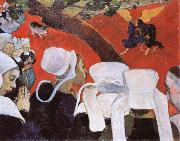
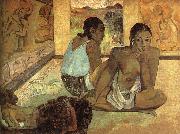
Unknown work
French
1848-1903
Paul Gauguin Art Locations
(born June 7, 1848, Paris, France ?? died May 8, 1903, Atuona, Hiva Oa, Marquesas Islands, French Polynesia) French painter, sculptor, and printmaker. He spent his childhood in Lima (his mother was a Peruvian Creole). From c. 1872 to 1883 he was a successful stockbroker in Paris. He met Camille Pissarro about 1875, and he exhibited several times with the Impressionists. Disillusioned with bourgeois materialism, in 1886 he moved to Pont-Aven, Brittany, where he became the central figure of a group of artists known as the Pont-Aven school. Gauguin coined the term Synthetism to describe his style during this period, referring to the synthesis of his paintings formal elements with the idea or emotion they conveyed. Late in October 1888 Gauguin traveled to Arles, in the south of France, to stay with Vincent van Gogh. The style of the two men work from this period has been classified as Post-Impressionist because it shows an individual, personal development of Impressionism use of colour, brushstroke, and nontraditional subject matter. Increasingly focused on rejecting the materialism of contemporary culture in favour of a more spiritual, unfettered lifestyle, in 1891 he moved to Tahiti. His works became open protests against materialism. He was an influential innovator; Fauvism owed much to his use of colour, and he inspired Pablo Picasso and the development of Cubism.
mk191
Oil on canvas
Painting ID:: 48750
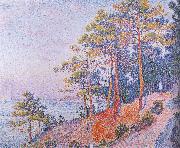
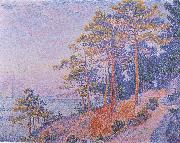
Unknown work
1863-1935
French
Paul Signac Galleries
Paul Victor Jules Signac was born in Paris on November 11, 1863. He followed a course of training in architecture before deciding at the age of 18 to pursue a career as a painter. He sailed around the coasts of Europe, painting the landscapes he encountered. He also painted scenes of cities in France in his later years.
In 1884 he met Claude Monet and Georges Seurat. He was struck by the systematic working methods of Seurat and by his theory of colours and became Seurat's faithful supporter. Under his influence he abandoned the short brushstrokes of impressionism to experiment with scientifically juxtaposed small dots of pure colour, intended to combine and blend not on the canvas but in the viewer's eye, the defining feature of pointillism.
Many of Signac's paintings are of the French coast. He left the capital each summer, to stay in the south of France in the village of Collioure or at St. Tropez, where he bought a house and invited his friends. In March 1889, he visited Vincent van Gogh at Arles. The next year he made a short trip to Italy, seeing Genoa, Florence, and Naples.
The Port of Saint-Tropez, oil on canvas, 1901Signac loved sailing and began to travel in 1892, sailing a small boat to almost all the ports of France, to Holland, and around the Mediterranean as far as Constantinople, basing his boat at St. Tropez, which he "discovered". From his various ports of call, Signac brought back vibrant, colourful watercolors, sketched rapidly from nature. From these sketches, he painted large studio canvases that are carefully worked out in small, mosaic-like squares of color, quite different from the tiny, variegated dots previously used by Seurat.
Signac himself experimented with various media. As well as oil paintings and watercolours he made etchings, lithographs, and many pen-and-ink sketches composed of small, laborious dots. The neo-impressionists influenced the next generation: Signac inspired Henri Matisse and Andr?? Derain in particular, thus playing a decisive role in the evolution of Fauvism.
As president of the Societe des Artistes Ind??pendants from 1908 until his death, Signac encouraged younger artists (he was the first to buy a painting by Matisse) by exhibiting the controversial works of the Fauves and the Cubists. mk191
Oil on canvas
Painting ID:: 48752
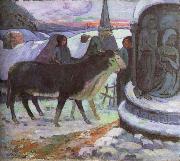
Unknown work
French
1848-1903
Paul Gauguin Art Locations
(born June 7, 1848, Paris, France ?? died May 8, 1903, Atuona, Hiva Oa, Marquesas Islands, French Polynesia) French painter, sculptor, and printmaker. He spent his childhood in Lima (his mother was a Peruvian Creole). From c. 1872 to 1883 he was a successful stockbroker in Paris. He met Camille Pissarro about 1875, and he exhibited several times with the Impressionists. Disillusioned with bourgeois materialism, in 1886 he moved to Pont-Aven, Brittany, where he became the central figure of a group of artists known as the Pont-Aven school. Gauguin coined the term Synthetism to describe his style during this period, referring to the synthesis of his paintings formal elements with the idea or emotion they conveyed. Late in October 1888 Gauguin traveled to Arles, in the south of France, to stay with Vincent van Gogh. The style of the two men work from this period has been classified as Post-Impressionist because it shows an individual, personal development of Impressionism use of colour, brushstroke, and nontraditional subject matter. Increasingly focused on rejecting the materialism of contemporary culture in favour of a more spiritual, unfettered lifestyle, in 1891 he moved to Tahiti. His works became open protests against materialism. He was an influential innovator; Fauvism owed much to his use of colour, and he inspired Pablo Picasso and the development of Cubism.
mk191
about 1896
Oil on canvas
72x83cm
Painting ID:: 48760
Unknown work
French
1848-1903
Paul Gauguin Art Locations
(born June 7, 1848, Paris, France ?? died May 8, 1903, Atuona, Hiva Oa, Marquesas Islands, French Polynesia) French painter, sculptor, and printmaker. He spent his childhood in Lima (his mother was a Peruvian Creole). From c. 1872 to 1883 he was a successful stockbroker in Paris. He met Camille Pissarro about 1875, and he exhibited several times with the Impressionists. Disillusioned with bourgeois materialism, in 1886 he moved to Pont-Aven, Brittany, where he became the central figure of a group of artists known as the Pont-Aven school. Gauguin coined the term Synthetism to describe his style during this period, referring to the synthesis of his paintings formal elements with the idea or emotion they conveyed. Late in October 1888 Gauguin traveled to Arles, in the south of France, to stay with Vincent van Gogh. The style of the two men work from this period has been classified as Post-Impressionist because it shows an individual, personal development of Impressionism use of colour, brushstroke, and nontraditional subject matter. Increasingly focused on rejecting the materialism of contemporary culture in favour of a more spiritual, unfettered lifestyle, in 1891 he moved to Tahiti. His works became open protests against materialism. He was an influential innovator; Fauvism owed much to his use of colour, and he inspired Pablo Picasso and the development of Cubism.
mk191
Oil on canvas
Painting ID:: 48761
Unknown work
French
1848-1903
Paul Gauguin Art Locations
(born June 7, 1848, Paris, France ?? died May 8, 1903, Atuona, Hiva Oa, Marquesas Islands, French Polynesia) French painter, sculptor, and printmaker. He spent his childhood in Lima (his mother was a Peruvian Creole). From c. 1872 to 1883 he was a successful stockbroker in Paris. He met Camille Pissarro about 1875, and he exhibited several times with the Impressionists. Disillusioned with bourgeois materialism, in 1886 he moved to Pont-Aven, Brittany, where he became the central figure of a group of artists known as the Pont-Aven school. Gauguin coined the term Synthetism to describe his style during this period, referring to the synthesis of his paintings formal elements with the idea or emotion they conveyed. Late in October 1888 Gauguin traveled to Arles, in the south of France, to stay with Vincent van Gogh. The style of the two men work from this period has been classified as Post-Impressionist because it shows an individual, personal development of Impressionism use of colour, brushstroke, and nontraditional subject matter. Increasingly focused on rejecting the materialism of contemporary culture in favour of a more spiritual, unfettered lifestyle, in 1891 he moved to Tahiti. His works became open protests against materialism. He was an influential innovator; Fauvism owed much to his use of colour, and he inspired Pablo Picasso and the development of Cubism.
mk191
oil on canvas
Painting ID:: 48763
Unknown work
1863-1935
French
Paul Signac Galleries
Paul Victor Jules Signac was born in Paris on November 11, 1863. He followed a course of training in architecture before deciding at the age of 18 to pursue a career as a painter. He sailed around the coasts of Europe, painting the landscapes he encountered. He also painted scenes of cities in France in his later years.
In 1884 he met Claude Monet and Georges Seurat. He was struck by the systematic working methods of Seurat and by his theory of colours and became Seurat's faithful supporter. Under his influence he abandoned the short brushstrokes of impressionism to experiment with scientifically juxtaposed small dots of pure colour, intended to combine and blend not on the canvas but in the viewer's eye, the defining feature of pointillism.
Many of Signac's paintings are of the French coast. He left the capital each summer, to stay in the south of France in the village of Collioure or at St. Tropez, where he bought a house and invited his friends. In March 1889, he visited Vincent van Gogh at Arles. The next year he made a short trip to Italy, seeing Genoa, Florence, and Naples.
The Port of Saint-Tropez, oil on canvas, 1901Signac loved sailing and began to travel in 1892, sailing a small boat to almost all the ports of France, to Holland, and around the Mediterranean as far as Constantinople, basing his boat at St. Tropez, which he "discovered". From his various ports of call, Signac brought back vibrant, colourful watercolors, sketched rapidly from nature. From these sketches, he painted large studio canvases that are carefully worked out in small, mosaic-like squares of color, quite different from the tiny, variegated dots previously used by Seurat.
Signac himself experimented with various media. As well as oil paintings and watercolours he made etchings, lithographs, and many pen-and-ink sketches composed of small, laborious dots. The neo-impressionists influenced the next generation: Signac inspired Henri Matisse and Andr?? Derain in particular, thus playing a decisive role in the evolution of Fauvism.
As president of the Societe des Artistes Ind??pendants from 1908 until his death, Signac encouraged younger artists (he was the first to buy a painting by Matisse) by exhibiting the controversial works of the Fauves and the Cubists. mk191
Oil on canvas
Painting ID:: 48769
Paul Signac 1863-1935
French
Paul Signac Galleries
Paul Victor Jules Signac was born in Paris on November 11, 1863. He followed a course of training in architecture before deciding at the age of 18 to pursue a career as a painter. He sailed around the coasts of Europe, painting the landscapes he encountered. He also painted scenes of cities in France in his later years.
In 1884 he met Claude Monet and Georges Seurat. He was struck by the systematic working methods of Seurat and by his theory of colours and became Seurat's faithful supporter. Under his influence he abandoned the short brushstrokes of impressionism to experiment with scientifically juxtaposed small dots of pure colour, intended to combine and blend not on the canvas but in the viewer's eye, the defining feature of pointillism.
Many of Signac's paintings are of the French coast. He left the capital each summer, to stay in the south of France in the village of Collioure or at St. Tropez, where he bought a house and invited his friends. In March 1889, he visited Vincent van Gogh at Arles. The next year he made a short trip to Italy, seeing Genoa, Florence, and Naples.
The Port of Saint-Tropez, oil on canvas, 1901Signac loved sailing and began to travel in 1892, sailing a small boat to almost all the ports of France, to Holland, and around the Mediterranean as far as Constantinople, basing his boat at St. Tropez, which he "discovered". From his various ports of call, Signac brought back vibrant, colourful watercolors, sketched rapidly from nature. From these sketches, he painted large studio canvases that are carefully worked out in small, mosaic-like squares of color, quite different from the tiny, variegated dots previously used by Seurat.
Signac himself experimented with various media. As well as oil paintings and watercolours he made etchings, lithographs, and many pen-and-ink sketches composed of small, laborious dots. The neo-impressionists influenced the next generation: Signac inspired Henri Matisse and Andr?? Derain in particular, thus playing a decisive role in the evolution of Fauvism.
As president of the Societe des Artistes Ind??pendants from 1908 until his death, Signac encouraged younger artists (he was the first to buy a painting by Matisse) by exhibiting the controversial works of the Fauves and the Cubists. Unknown work mk191
Oil on canvas