WTEWAEL, Joachim Dutch painter (b. 1566, Utrecht, d. 1638, Utrecht).
Dutch painter and draughtsman. He was one of the last exponents of MANNERISM. From c. 1590 until 1628, the year of his latest known dated paintings, he employed such typical Mannerist formal devices as brilliant decorative colour, contrived spatial design and contorted poses. He sometimes combined such artifice with naturalism, and this amalgam represents the two approaches Dutch 16th- and 17th-century theorists discussed as uyt den geest ('from the imagination') and naer 't leven ('after life'). Wtewael's activity reflects the transition from Mannerism to a more naturalistic style in Dutch art. Slightly over 100 of his paintings and about 80 drawings are known. Subjects from the Bible and mythology predominate;

WTEWAEL, Joachim Dutch painter (b. 1566, Utrecht, d. 1638, Utrecht).
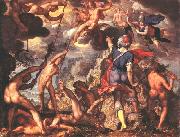
Dutch painter and draughtsman. He was one of the last exponents of MANNERISM. From c. 1590 until 1628, the year of his latest known dated paintings, he employed such typical Mannerist formal devices as brilliant decorative colour, contrived spatial design and contorted poses. He sometimes combined such artifice with naturalism, and this amalgam represents the two approaches Dutch 16th- and 17th-century theorists discussed as uyt den geest ('from the imagination') and naer 't leven ('after life'). Wtewael's activity reflects the transition from Mannerism to a more naturalistic style in Dutch art. Slightly over 100 of his paintings and about 80 drawings are known. Subjects from the Bible and mythology predominate; The Battle Between the Gods and the Titans iyu 1600
Oil on copper
Art Institute of Chicago, Chicago
Kitchen Scene wer 1605
Oil on canvas, 65 x 98 cm
Staatliche Museen, Berlin Painting ID:: 9770
WTEWAEL, Joachim Dutch painter (b. 1566, Utrecht, d. 1638, Utrecht).
Dutch painter and draughtsman. He was one of the last exponents of MANNERISM. From c. 1590 until 1628, the year of his latest known dated paintings, he employed such typical Mannerist formal devices as brilliant decorative colour, contrived spatial design and contorted poses. He sometimes combined such artifice with naturalism, and this amalgam represents the two approaches Dutch 16th- and 17th-century theorists discussed as uyt den geest ('from the imagination') and naer 't leven ('after life'). Wtewael's activity reflects the transition from Mannerism to a more naturalistic style in Dutch art. Slightly over 100 of his paintings and about 80 drawings are known. Subjects from the Bible and mythology predominate; Kitchen Scene wer 1605
Oil on canvas, 65 x 98 cm
Staatliche Museen, Berlin
Mars and Venus Discovered by the Gods wer 1603-04
Oil on copper, 20,2 x 15,5 cm
Private collection Painting ID:: 9771
WTEWAEL, Joachim Dutch painter (b. 1566, Utrecht, d. 1638, Utrecht).
Dutch painter and draughtsman. He was one of the last exponents of MANNERISM. From c. 1590 until 1628, the year of his latest known dated paintings, he employed such typical Mannerist formal devices as brilliant decorative colour, contrived spatial design and contorted poses. He sometimes combined such artifice with naturalism, and this amalgam represents the two approaches Dutch 16th- and 17th-century theorists discussed as uyt den geest ('from the imagination') and naer 't leven ('after life'). Wtewael's activity reflects the transition from Mannerism to a more naturalistic style in Dutch art. Slightly over 100 of his paintings and about 80 drawings are known. Subjects from the Bible and mythology predominate; Mars and Venus Discovered by the Gods wer 1603-04
Oil on copper, 20,2 x 15,5 cm
Private collection
Perseus and Andromeda wet 1611
Oil on canvas, 180 x 150 cm
Mus??e du Louvre, Paris Painting ID:: 9772
WTEWAEL, Joachim Dutch painter (b. 1566, Utrecht, d. 1638, Utrecht).
Dutch painter and draughtsman. He was one of the last exponents of MANNERISM. From c. 1590 until 1628, the year of his latest known dated paintings, he employed such typical Mannerist formal devices as brilliant decorative colour, contrived spatial design and contorted poses. He sometimes combined such artifice with naturalism, and this amalgam represents the two approaches Dutch 16th- and 17th-century theorists discussed as uyt den geest ('from the imagination') and naer 't leven ('after life'). Wtewael's activity reflects the transition from Mannerism to a more naturalistic style in Dutch art. Slightly over 100 of his paintings and about 80 drawings are known. Subjects from the Bible and mythology predominate; Perseus and Andromeda wet 1611
Oil on canvas, 180 x 150 cm
Mus??e du Louvre, Paris
Dutch painter (b. 1566, Utrecht, d. 1638, Utrecht).
Dutch painter and draughtsman. He was one of the last exponents of MANNERISM. From c. 1590 until 1628, the year of his latest known dated paintings, he employed such typical Mannerist formal devices as brilliant decorative colour, contrived spatial design and contorted poses. He sometimes combined such artifice with naturalism, and this amalgam represents the two approaches Dutch 16th- and 17th-century theorists discussed as uyt den geest ('from the imagination') and naer 't leven ('after life'). Wtewael's activity reflects the transition from Mannerism to a more naturalistic style in Dutch art. Slightly over 100 of his paintings and about 80 drawings are known. Subjects from the Bible and mythology predominate;